
European Heart Journal – Digital Health, 2026
DeepRV: right ventricular function from routine coronary angiograms
Automated assessment of right ventricular systolic function from coronary angiograms with video-based artificial intelligence algorithms: development, validation, comparison against humans, and prospective deployment
Fatima Zahra Fawzi, Istok Menkovic, Nicolas Dostie, Maxime Tremblay-Gravel, Marie-Claude Parent, Gabriel Asslo, Jean-François Tanguay, Guillaume Marquis-Gravel, Minhaj Ansari, Joshua P. Barrios, Geoffrey H. Tison, Jacques Delfrate, Robert Avram

Why it matters
Right ventricular systolic function shapes decisions in the catheterization laboratory, including whether to escalate to mechanical circulatory support. During urgent angiography, an echocardiogram is often not available.
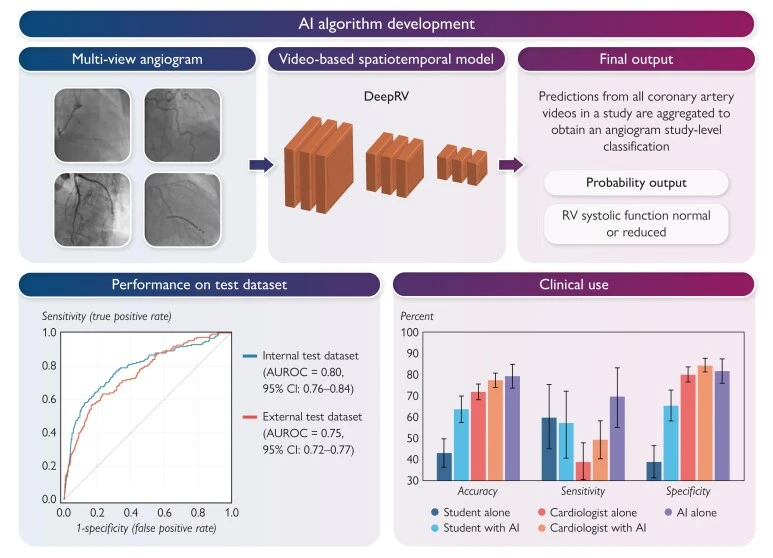
DeepRV is a video-based deep neural network that reads the left and right coronary angiograms already acquired during the procedure and classifies right ventricular systolic function as normal or reduced. It was developed on 8,053 angiography studies from the Montreal Heart Institute (2017 to 2023), with echocardiography as the reference.
Validation
Area under the ROC curve with 95% confidence interval, from development to prospective use.
Internal test set
Montreal Heart Institute
1,586 studies, 10.5% with reduced function
0.80 (0.76–0.84)
External validation
University of California, San Francisco
2,247 studies
0.75 (0.72–0.77)
Prospective deployment
Primary PCI for STEMI, Montreal Heart Institute
82 patients, post-PCI angiogram
0.83 (0.71–0.93)
On the internal test set: sensitivity 70.5%, specificity 78.5%, negative predictive value 95.8%.
Readers with and without DeepRV
Accuracy for identifying reduced right ventricular function on 200 angiography studies.
Medical students
43.5% 64.0%
Alone → With DeepRV
Cardiologists
72.1% 77.6%
Alone → With DeepRV
DeepRV alone
79.5%
DeepRV alone had the highest accuracy (79.5%) and sensitivity (70.0%). Cardiologists using DeepRV had the highest specificity (84.6%).
Running in the cath lab through PACS-AI
Angiograms reach PACS in real time. PACS-AI lets the operator request a DeepRV prediction during the procedure and returns the result in the catheterization laboratory, with a median inference time of 5.1 seconds in the prospective STEMI cohort.
Intended use and limitations
- Best suited as a rule-out tool during coronary angiography, given its high negative predictive value.
- It does not replace echocardiography for a full right ventricular assessment.
- Performance in cardiogenic shock and isolated right ventricular infarction needs dedicated validation; these groups were small.
- Race and ethnicity data were not available, so fairness across groups could not be assessed.
- Available on PACS-AI for research use. It is not approved by the FDA or Health Canada.
Cite this work
Fawzi FZ, Menkovic I, Dostie N, et al. Automated assessment of right ventricular systolic function from coronary angiograms with video-based artificial intelligence algorithms: development, validation, comparison against humans, and prospective deployment. Eur Heart J Digit Health. 2026;7(4):ztag059. doi:10.1093/ehjdh/ztag059
Subscribe to our newsletter to keep updated.

 Status Terms and Conditions Privacy Policy Privacy Impact Assessment Document (EFVP)
 © 2026 HeartWise AI Lab, Montreal Heart Institute. All rights reserved.